Gyumri Art Week 2026
August 7-20, 2026
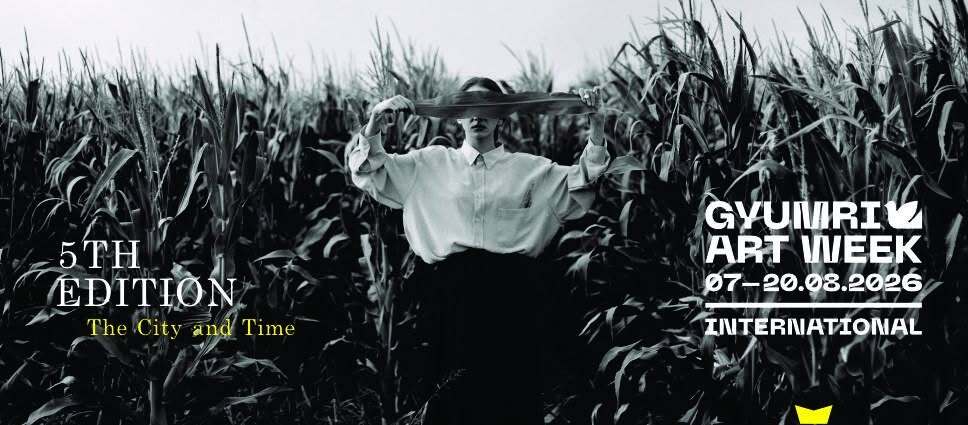
City and Time
The festival explores how a city is shaped over time and how time “lives” within the city. It brings together the past, present and future, presenting the city as a living organism that is constantly changing and reshaping itself.
In today’s world, where digitalization, demographic change and the challenges of sustainable development are becoming increasingly complex, there is a need for new thinking about the relationship between time and the city. These challenges do not merely disrupt established urban paradigms; they also create new opportunities to rethink urban life and its structure.
This year’s festival focuses on the interactions within the city, revealing the meeting ground between the organized city and the free imagination of art. Urban life is often structured by clear planning and regulation principles, while art offers spontaneous and experimental interruptions that expand the boundaries of perception of these systems.
Between artistic practices, the city is considered both as a concept, as a physical reality and as a temporal process. This is the environment where experiences are shaped, where possibilities are defined and often also where limitations are defined.
The festival explores how the approaches proposed by artists transform the city into sharp reliefs, making it more visible and tangible. These interventions activate momentary encounters where new expressions and interactions can arise.
This ideological framework parallels Henri Lefebvre’s theory of the “right to the city”, where the city is considered not only as a physical space, but as an experience that must be constantly reinterpreted by its inhabitants. In his formulation, the city is “made by the people who live in it”, which emphasizes the importance of participation and creative intervention.
In recent decades, cities have been subjected to multiple influences, from neoliberal economic policies to climate change, from industrialization to post-industrial transformations, as well as growing social inequalities. In this context, fundamental questions arise:
What is it like to live in modern cities?
What are the main forces shaping cities and neighborhoods?
To what extent are people connected or divided?
And how do these processes differ across cultures and globally?
The City and Time Festival offers an interdisciplinary platform where artists, researchers, and the public explore these questions together. It aims to shape an evolving discourse on the relationship between urban environments and time, making the city visible through art and reimagining public spaces.
The festival views art not only as a means of expression, but also as a critical tool that can reveal, reimagine, and reconstruct our understanding of the city.